
As a nonwoven manufacturer with years of industry experience, we receive B2B inquiries daily. The most common question? "What's your price?"
Honestly, this question makes us feel both encouraged and concerned. Encouraged because there's interest—concerned because in 2026, the era of pure price comparison is over.
If you're a hygiene product brand owner, medical procurement manager, or industrial filtration manufacturer, this article is written for you. We want to discuss what truly determines your end product's competitiveness in today's "price war" market environment.
Let's look at some industry signals first:
The global nonwoven fabric market was valued at USD 60.93 billion in 2025 and is projected to reach USD 86.55 billion by 2031, growing at a CAGR of 6.03% . Sustained demand from healthcare, construction, and automotive applications continues to accelerate investment in spunbond manufacturing lines .
Regulatory momentum around microplastic leakage and recyclable packaging is reshaping product design toward biodegradable or circular solutions, pushing rayon, lyocell, and natural-fiber blends into mainstream specifications .
Meanwhile, domestic markets face intense price competition and product homogenization, with profit margins continuously compressed.
So here's the question: In this environment, how should B2B buyers break through?
The answer is simple: Upgrade your procurement logic from "inquiry-comparison" to "technology-value" assessment.
The four core technology trends below are your "procurement navigation map" and "value discovery guide" for 2026.
Your Pain Points:
Finally secured a European order, only to have it returned for non-compliance with environmental standards
The threshold for the EU's plastics strategy is getting higher and higher, unsure how to respond
Technology Explained
"Flushable" and "biodegradable" are the hottest technology directions in nonwovens today. Flushable nonwovens rapidly disintegrate in water without clogging sewage systems. Biodegradable nonwovens decompose into water and CO₂ under specific environmental conditions through microbial action.
According to Professor Xianyu Jin from Donghua University: "In the post-pandemic era, more companies are transitioning from medical protection to broader health sectors, and biodegradable, flushable materials are key to future competition" .
The Sustainability Push at INDEX26
The world's largest nonwovens trade fair, INDEX26 (taking place in Geneva, May 19–22, 2026), will showcase the latest sustainable innovations . The focus will be on trends in the circular economy, regulatory requirements, and the transformation to CO₂- and resource-efficient manufacturing processes .
Several raw material suppliers and nonwovens manufacturers exhibiting at INDEX26 are now opting for ISCC PLUS certification for bio-based feedstocks, including BASF, ExxonMobil, Indorama Ventures, Magnera, and Teijin Frontier .
Value for B2B Buyers
For buyers targeting Western markets, selecting suppliers with environmental technologies gives you a "green pass" to market access.
Regulatory Timeline: By 2026, expect continued tightening of microplastic and landfill regulations globally . The industry is responding with greater material efficiency, recycling initiatives, and the development of biodegradable polymers .
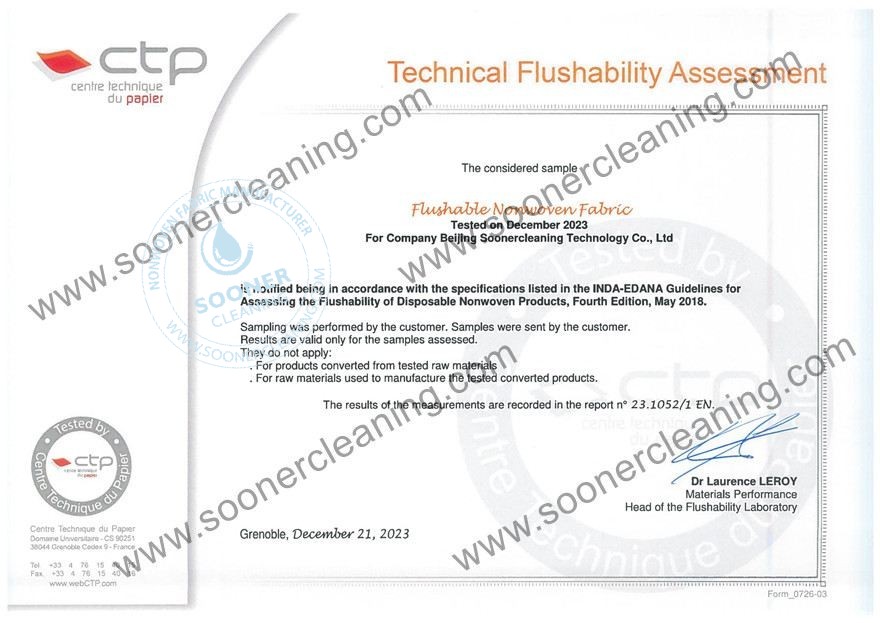
Our company has fully deployed biodegradable materials technology with products passing international certifications, helping you access global markets confidently. Scan the QR code at the end of this article to receive our eco-materials product catalog.
Your Pain Points:
Large suppliers' MOQs are too high for small/medium brands to handle
Market products look identical, but you can't find a partner to create differentiation
Technology Explained
Smart manufacturing is fundamentally changing nonwoven production. Through MES systems and digital workshops, leading companies have achieved "72-hour sampling to 15-day mass production" rapid response capabilities.
Latest Innovations at INDEX26
Magnera Corp. is presenting breathable backsheet solutions with a reduced basis weight of only 8 g/m². Combined with an ultra-soft, thin nonwoven fabric of 10 g/m², this creates a very lightweight, breathable solution that reduces material consumption, lowers freight costs, and shortens delivery times without compromising comfort or quality .
Wisdom Greentech Ltd. is pushing the boundaries of softness with the world's first nonwoven fabric made from 0.44 dtex fibers. The product has a skin contact layer made of 100% cotton and is manufactured without chemical binders or ultrasonic bonding .
Reifenhäuser's new RF6 technology for spunmelt production enables higher throughput for the finest fibers while offering user-friendly and low-maintenance operation .
What This Means for You
Lower inventory risk: Digital production allows smaller, multi-batch production runs. You can test markets with smaller quantities, then scale based on feedback.
Functional customization: Beyond color changes, suppliers can customize functions for your specific end-use scenarios:
High-breathability medical nonwovens for tropical Southeast Asian markets
Engineered filtration materials for industrial high-temperature applications
Custom dyeing using masterbatch pigments with Pantone matching
This "technology marketing" capability gives your products genuine differentiated competitive advantages.
We operate industry-leading smart production lines supporting small-batch customization and rapid sampling. Tell us your application scenario—we'll provide samples within 72 hours.
Your Pain Points:
End consumers are increasingly demanding—they want protection AND breathability AND antibacterial properties
Low-cost nonwovens can't satisfy these "both-and" requirements
Technology Explained
Multi-layer composite structures are the solution. By combining different layers (spunbond-meltblown-spunbond or SMS), manufacturers can achieve both high protection levels and breathability without increasing weight.
Medical Applications Driving Innovation
In modern operating theatres, nonwoven fabrics—primarily as spunmelt fabrics and laminates—deliver consistent barrier protection. Unlike woven textiles where yarn movement creates unpredictable pore structure, spunmelt nonwovens are engineered with uniform density and filtration characteristics .
Layered composites offer soft inner surfaces against the skin combined with durable outer layers that withstand surgical handling stresses .
Advanced Wound Care Breakthroughs
Antimicrobial Polymer Technology (APT™) has been integrated into POLTX_Fiber™, a Class IIb advanced wound care dressing that prevents bacterial colonization within the dressing without contributing to antimicrobial resistance . This represents a new standard in wound care, demonstrating how nonwovens can incorporate sophisticated antimicrobial functions.
Smart wound-care substrates incorporating controlled vapor transmission films and super-absorbent cores are moving from pilot to high-volume production, improving healing environments and reducing dressing changes .
Electrospun nanofibers based on polyimide or PEEK deliver elevated heat resistance for powered air-purifying respirators and implantable devices .
Value for B2B Buyers
For medical,maternal and child, and sensitive applications, antibacterial functionality is no longer a "nice-to-have"—it's becoming table stakes.
OEKO-TEX® Compliance Note: Since June 2025, biocides are prohibited in all OEKO-TEX® STANDARD 100 certified products for baby items and products with direct mucosal contact (diapers, sanitary napkins, etc.). Traditional chemical antimicrobials are being phased out—physical antimicrobial mechanisms and photocatalytic technologies are becoming mainstream.
We have mastered multiple core technologies including advanced composite structures and antimicrobial functionalities, with product performance matching international brands at more competitive costs. Click here to explore our technology portfolio.
Your Pain Points:
Supplier suddenly stops production, disrupting your manufacturing
Raw material price volatility makes costs unpredictable
Quality issues arise with no clear cause—you absorb the loss
Technology Explained
You may not realize it, but these "invisible" costs often exceed the purchase price by multiples.
Leading nonwoven companies are implementing two critical practices:
Transparent Production: Opening smart scheduling systems or VR factory tours for "supply chain visibility". You can see where your order is on the production line and estimated delivery timing in real time.
Deep Technical Service: Not just selling products, but providing integrated "production-research-sales" support.
The Traceability Advantage
Companies like Lenzing are employing platforms such as TextileGenesis™ and engaging in industry-wide standards to enable seamless data exchange and digital documentation. This maintains robust digital chain of custody, benefiting partners by mitigating risks and reinforcing authenticity .
Value for B2B Buyers
For B2B customers, a supplier offering "on-site service engineers" and "risk-sharing mechanisms" is your solid foundation for stable production.
Procurement Best Practices:
Require batch-specific test reports—don't rely solely on generic certifications
Use third-party inspection services (SGS, TÜV) for first bulk orders above 5,000 kg
Define specifications in writing: grammage tolerance (±5%), roll diameter, core size, edge trimming requirements
Negotiate milestone payments: 30% deposit, 40% after sample approval, 30% before shipment
Top-tier suppliers provide tracking updates and proactive delay notifications. Prioritize those with ≤4-hour response times, especially when managing tight project timelines .
We don't just sell products—we provide full-process technical support and supply chain visualization. Choosing us means adding insurance to your production.
The nonwoven industry in 2026 is undergoing profound transformation:
Green: Biodegradable, flushable becoming standard specifications
Lightweight: 0.44dtex ultra-fine fibers redefining "softness"
Smart: Intelligent manufacturing enabling rapid customization
Functional: Antimicrobial, cooling, and other composite functions continuously advancing
CINTE25 revealed that China's technical textiles industry is moving from "manufacturing" to "smart manufacturing," from "traditional" to integration of "green and intelligent" . Professor Xiaoming Qian from Tianjin Polytechnic University noted: "The entire industry is developing toward differentiation, health-orientation, and specialization led by innovation" .
For B2B buyers, this means your procurement logic must upgrade:
Why should we pay attention to the number of technical patents held by suppliers? (Industry invention patents reached 7,931 by 2024 )
Why inquire about the supplier's level of intelligent manufacturing? (Directly impacts delivery cycles and customization capabilities)
Why should we attach importance to environmental certification? (Directly affects export market compliance)
In this "technology-first" era, pure price comparison traps you in a vicious cycle. Smart procurement identifies technology value and selects partners for mutual growth.
As a technology-focused nonwoven manufacturer, we're ready to be that partner.
【About Us】
We are a leading nonwoven technology company with:
✅ Smart production lines supporting 72-hour rapid sampling
✅ Multiple core technology patents covering biodegradable, antimicrobial, ultra-fine fiber areas
✅ Full supply chain visualization with real-time order tracking
✅ Professional technical service team providing on-site support
【How to Access More Value?】
We've prepared exclusive benefits for B2B clients:
👉 Comment below "I want to learn about technical solutions for [your product type]"—receive a customized proposal within 72 hours
Technology makes partnerships more valuable. We look forward to creating the future with you!