
In the realm of personal care and hygiene, few innovations have bridged the gap between convenience and environmental responsibility as effectively as the flushable wet wipe. At the heart of this revolution lies a specific manufacturing process: Water Jet Bonded Nonwoven production. For manufacturers and consumers alike, understanding how high-pressure water transforms loose fibers into a sturdy cloth that disappears after flushing is the key to appreciating modern flushability.
This article explores the science, standards, and sustainability of flushable spunlace materials, offering insights into why this technology is the gold standard for the next generation of biodegradable hygiene products.
To understand flushability, one must first understand the bond.
In the nonwoven world, fibers must be held together to form a fabric. Traditional methods might use chemical latex binders or thermal bonding (melting synthetic fibers together). However, the water jet bonded nonwoven process—technically known as spunlace—uses purely mechanical force.
During the spunlace process, fine, high-pressure water jets penetrate a web of fibers. These jets create a turbulence that causes the fibers to twist and entangle around one another like a microscopic knot . Because this bond is physical rather than chemical, it creates a unique duality:
🔹Wet Strength: When saturated with cleaning solutions, the fibers hold tight, providing the durability needed for effective cleaning without tearing.
🔹Triggered Dispersion: When exposed to the extreme turbulence and dilution of a toilet bowl and municipal plumbing, these mechanical knots have the ability to "unravel."
Not every product labeled "flushable" meets the mark. For a water jet bonded nonwoven to be genuinely safe for sewer systems, it must pass rigorous international standards, such as those defined by EDANA (European Disposables and Nonwovens Association) and INDA (North American Nonwovens Association).
True flushability requires two distinct characteristics:
🔹Dispersibility: The material must break down into small pieces quickly in a simulated drainage system (often tested via slosh box methods)
🔹Biodegradability: Once dispersed, the fibers must be assimilated by the microbial environment. This is where the choice of raw material is critical.
Modern flushable spunlace relies on 100% natural cellulose fibers (such as wood pulp from sustainable forestry) and plant-based fibers like viscose or lyocell. Unlike polyester or polypropylene, these natural fibers are consumed by bacteria in septic systems and wastewater treatment plants, ensuring the material is fully biodegradable.
Recent advancements have refined the water jet bonded nonwoven process specifically for flushability. The industry has moved toward hybrid technologies, most notably the Wetlace process.
This technique combines wet-laid (similar to papermaking) and spunlace technologies:
🔹Wet-laid Formation: Short natural fibers (like wood pulp) are suspended in water and laid onto a moving screen. This ensures a homogeneous, paper-like base.
🔹High-Pressure Entanglement: Instead of using chemical binders to hold the pulp in place, the web passes under water jets. The spunlace energy creates a reinforcing net without adding mass.
This method solves an old puzzle: paper is dispersible but too weak when wet, while traditional nonwovens are strong but do not break apart. Water jet bonded nonwoven technology using the Wetlace method creates a material that feels like cloth but behaves like paper when flushed.
The shift toward flushable and biodegradable nonwovens is not just a trend; it is a regulatory and environmental necessity.
Conventional nonwoven wipes, even those labeled as flushable by some brands, have been major contributors to sewer blockages known as "fatbergs" when they contain plastic binders or long synthetic fibers . Water jet bonded materials, specifically designed to meet INDA/EDANA guidelines, disintegrate quickly enough to mitigate this risk.
European regulations like the SUPD (Single-Use Plastics Directive) and consumer pressure are pushing brands to prove biodegradability. A true water jet bonded nonwoven designed for flushability uses fibers that can biodegrade in soil or aquatic environments within a reasonable timeframe, leaving no microplastic residue .
Data indicates a surge in demand for flushable products, particularly among environmentally conscious consumers in urban areas . The convenience of hygienic cleaning (wetness) combined with the guilt-free disposal (flushability) makes spunlace the ideal substrate.
As we look toward 2026 and beyond, the innovation in water jet bonded nonwoven technology continues. We are seeing developments in:
🔹Alternative Fibers: Beyond traditional wood pulp, manufacturers are exploring bamboo, hemp, and even agricultural waste fibers that maintain the strength required for the spunlace process while enhancing the biodegradable profile.
🔹Dispersion Speed: New generation spunlace products are engineered to disperse in minutes rather than hours, ensuring compatibility with aging municipal infrastructure worldwide.
🔹Standardization: With national standards emerging for flushable spunlace, the definition of a bond that is strong enough to use but weak enough to disappear is becoming legally defined, protecting both brands and sewer systems.
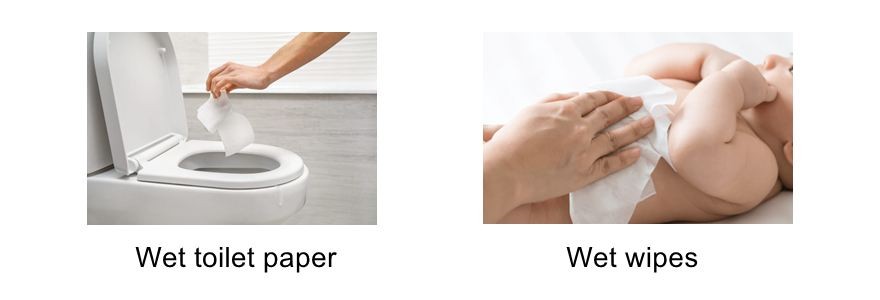
The water jet bonded nonwoven is the master key to flushability. By harnessing the power of water to bond fibers without chemicals, the spunlace industry has created a product category that offers the premium experience of a washcloth with the disposability of toilet paper.
For producers, investing in advanced spunlace lines capable of processing natural fibers ensures a place in the growing market for flushable and biodegradable hygiene products. It is a perfect synergy of mechanical engineering and environmental stewardship, proving that sometimes, the strongest bond is the one that knows when to let go.