
Market data cited in this article: The global flushable biodegradable nonwoven fabric market was valued at USD 1.45 billion in 2024 and is projected to reach USD 3.28 billion by 2032, growing at a CAGR of 9.3%.
For US and European consumers, disposing of wet wipes in the toilet is second nature. For municipal wastewater systems, however, this habit creates an expensive nightmare. Conventional nonwovens (such as baby wipes) offer convenience but become primary culprits in sewer blockages—forming massive "fatbergs" that plague urban infrastructure.
As environmental regulations tighten across North America and Europe, a fundamental industry transformation is underway. For nonwoven fabric suppliers, mastering authentic flushability and biodegradability technologies is no longer optional—it represents your strategic shield against regulatory risk and your passport to essential Western markets.
The era of marketing "flushable" claims without rigorous scientific validation has ended. In today's regulatory environment, substantiation through standardized testing is mandatory.
The proposed federal WIPPES (Wastewater Infrastructure Pollution Prevention and Environment Safety) Act continues to reshape market rules. This legislation mandates that non-flushable wipes bear conspicuous "Do Not Flush" labeling. The implication is clear: only products passing stringent testing can confidently market themselves as "flushable."
State-level initiatives are advancing even more rapidly. Minnesota's HF 3491, effective August 2025, requires that products claiming to be "flushable" or "septic-safe" demonstrate compliance with specific dispersibility standards . New York and other states have introduced similar documentation requirements. Claims of "biodegradability" alone are insufficient—flushability performance must be verifiable through recognized test methods.
The EU's Empowering Consumers Directive (ECD) is now fully effective, while the Green Claims Directive (GCD)—despite implementation timelines—establishes that environmental marketing claims must be scientifically substantiated. Vague eco-language invites regulatory action. Claims of "biodegradable" performance require independent third-party validation and traceable documentation.
Significantly, Standards Australia released a new national standard in 2022 that explicitly builds upon the INDA/EDANA GD4 test methods and criteria. Belgian and Spanish authorities have similarly adopted GD4 provisions into law, with Spain's UNE 149002 standard requiring both GD4 dispersion testing and "Do Not Flush" labeling for non-flushable products. This global convergence around GD4 creates a unified compliance framework for international suppliers.
For nonwoven professionals, a critical distinction must be made: visible disintegration does not equal passing certification. Authentic flushability requires simultaneous satisfaction of physical dispersion and biological degradation standards.
The INDA/EDANA Fourth Edition Guidelines for Assessing the Flushability of Disposable Nonwoven Products (GD4) represents the industry's most rigorous benchmark. Key enhancements from previous editions include:
Slosh Box Dispersion Testing: Test duration reduced from 180 minutes to 60 minutes, with the percentage of material passing through 12.5mm screens increased from 25% to 60%
Municipal Pump Test: Allowable power increase reduced from 15% average to 5% average, ensuring compatibility with wastewater pumping infrastructure
Critical technical insight: Authentic flushable spunlace nonwovens require precise control of wood pulp-to-viscose fiber ratios and hydroentanglement parameters. The material must maintain sufficient wet strength during use (preventing premature breakdown) while dispersing rapidly under the shear forces, agitation, and biological conditions present in wastewater systems.
China's equivalent standards—including GB/T 40181-2021 and T/YNA 014-2023—establish technical requirements for aerobic and anaerobic biodegradation that align with international benchmarks . Qualified Chinese suppliers possess the technical capability to serve as compliant partners for global brands.
If flushability addresses "physical non-blockage," biodegradability addresses "environmental microplastic persistence."
The EU Bioeconomy Strategy explicitly prioritizes reducing fossil fuel dependence and promoting sustainable biomass materials. A wipe that disperses physically but leaves behind non-degradable synthetic fibers (such as polyester) continues to pollute—entering waterways through treatment systems and becoming marine microplastic pollution.
The essential "dual-green" requirement:
Material composition: Natural fibers (wood pulp, cotton) or certified biodegradable synthetics (PLA, viscose)
Process technology: Mechanical entanglement (hydroentanglement/spunlace) rather than chemical binders, ensuring the completed product—like toilet paper—completes its lifecycle by converting to water and carbon dioxide in treatment facilities or septic systems.
Your brand customers face escalating litigation exposure. Today's sophisticated buyers require more than marketing brochures—they demand compliance packages that include:
Supply testing reports aligned with GD4 protocols or equivalent international standards (ISO 14855 for aerobic biodegradation, OECD 301, EN 13432). This includes documented dispersion rates, settling characteristics, and biodegradation percentages.
US and European buyers increasingly require compliance with Digital Product Passport (DPP) concepts emerging from EU Ecodesign regulations. Providing fiber source certifications (FSC-certified wood pulp) and carbon footprint data enables your customers to demonstrate supply chain transparency to end consumers.
Assist customers in ensuring all "biodegradable" claims are validated through ISO 14855 or equivalent testing protocols, providing legal defense under evolving green claims legislation.
Leading Chinese suppliers now operate vertically integrated facilities with:
Cleanroom environments exceeding 3,000m²
In-house R&D for functional formulations
Third-party testing partnerships (SGS, TÜV, Bureau Veritas)
Spunlace lines optimized for dispersible cellulose fiber processing
The flushable wipes market is projected to expand by USD 10.78 billion between 2025 and 2029, with Europe contributing 34% of global growth. While non-biodegradable products currently hold 69% market share due to lower production costs, the biodegradable segment is accelerating rapidly as environmental awareness and regulatory pressure intensify.
Analysis of Google search data reveals that "flushable toilet wipes" maintains the highest and most consistent search volume, with distinct seasonal peaks during summer and fall months. This indicates that flushability functionality remains the primary consumer concern, with biodegradability serving as an increasingly important secondary qualification.
Asia-Pacific leads global production capacity, driven by strong manufacturing infrastructure, raw material access (wood pulp, bamboo, viscose), and established export logistics. Provinces including Zhejiang, Jiangsu, and Shandong host concentrations of eco-focused hygiene manufacturers equipped with advanced spunlace lines that balance wet strength during use with rapid wastewater disintegration.
Within manufacturing processes, wet laid technology is projected to show the highest growth rate, favored for producing high-strength, dispersible fabrics that meet both durability requirements and rapid sewage system breakdown. This technology's compatibility with diverse biodegradable fibers positions it as a key focus area for forward-looking manufacturers.
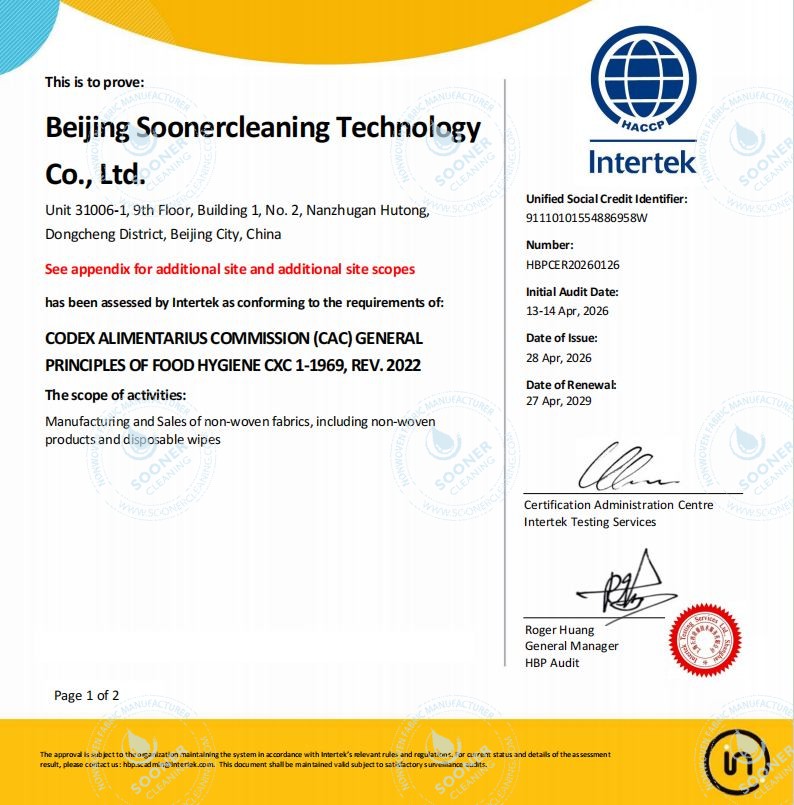
The North American and European demand for flushable wet wipes has evolved from "optional selling point" to "essential category requirement." As the WIPPES Act framework advances nationally and state-level legislation multiplies, regulatory advantage increasingly favors technically prepared suppliers.
For nonwoven fabric suppliers, this moment offers an opportunity to demonstrate technical capability. By mastering GD4-compliant dispersion performance and full-lifecycle biodegradability, we supply more than material—we deliver future market access for global brands.
Is your supply chain ready for 2026 compliance requirements? [Contact Soonercleaning] for detailed white papers, third-party test reports, and compliance consultation.