With the growth of the wet toilet paper and eco-friendly wipe markets, more and more brands are turning their attention to flushable wipe material. However, many buyers encounter a common question when selecting raw materials:
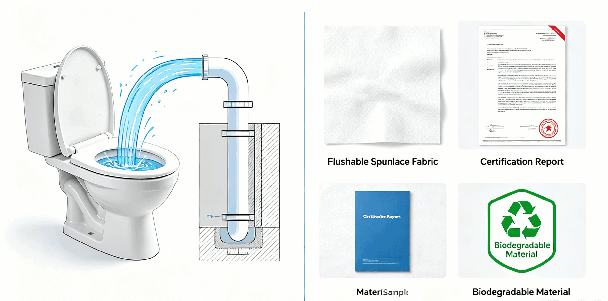
What exactly is the difference between flushable material and ordinary nonwoven fabric?
Although the two look very similar in appearance, there are significant differences in fiber structure, disintegration performance, application scenarios, and market compliance requirements. Understanding these differences helps procurement professionals select the most suitable material solution for their projects.
1. Differences in Disintegration Performance
The biggest difference lies in whether the material can disintegrate quickly after being flushed.
Standard nonwoven fabric primarily emphasizes strength and durability, maintaining its structural integrity even after prolonged immersion in water.
Flushable wipe materials, on the other hand, are specially designed to meet the required strength while gradually disintegrating once they enter the sewer system, thereby reducing the risk of clogs.
This property is particularly important for flushable toilet paper products.
2. Different Fiber Compositions
Standard wipe materials typically use:
Polyester (PET)
Polypropylene (PP)
Viscose
Flushable materials, however, more commonly use:
Wood pulp fibers
Viscose fibers
Biodegradable fibers
By optimizing fiber ratios and structural design, a balance between strength and dispersibility is achieved.
3. Different Production Process Requirements
Conventional nonwovens primarily focus on:
Strength
Abrasion resistance
Cost control
In contrast, flushable spunlace nonwovens require stricter process control, including:
Spunlace entanglement strength
Fiber length control
Dispersibility design
Their production is generally more challenging than that of conventional nonwoven products.
4. Different Market Access Requirements
For the European and American markets, flushable wet wipe products typically need to comply with relevant industry standards.
For example:
INDA/EDANA GD4
IWSFG Flushability Guidelines
Brands and retailers often require suppliers to provide relevant test reports.
In contrast, conventional nonwovens generally do not require flushability testing.
5. Different Application Areas
Standard nonwovens are widely used in:
-
Baby wipes
-
Cleaning wipes
-
Industrial wipes
-
Medical care products
Flushable wipe materials are primarily used in:
-
Flushable toilet paper
-
Flushable wipes
-
Personal care products
Their core objective is to meet flushability requirements while ensuring a positive user experience.
Why Are More and More Brands Choosing Flushable Materials?
As consumer environmental awareness grows and market regulations become increasingly stringent, flushable wipes are gradually becoming an industry trend.
For brands, adopting standard-compliant flushable materials not only helps enhance product competitiveness but also reduces market compliance risks.
Conclusion
Although flushable wipe materials and standard nonwovens appear very similar, there are fundamental differences between them in terms of fiber structure, dispersion performance, production processes, and application areas.For brands planning to enter the wet toilet paper or flushable wipes market, selecting the right raw materials is a crucial foundation for product success.
