
By Matt Louis, Senior Nonwoven Materials Engineer
Published: April 2026 | 8 min read
For wet wipes manufacturers serving the US and European markets, 2025–2026 marks a watershed moment. The era of labeling wipes as “flushable” without rigorous scientific substantiation is over. State-level legislation in the United States, coupled with the EU’s tightened Green Claims Directive, has fundamentally reshaped the compliance landscape.
For nonwoven fabric buyers and wipes converters, understanding what authentic flushability means—and how to source GD4-compliant materials—is now a business-critical requirement. This guide provides a comprehensive, technically grounded overview of flushable nonwoven standards, testing protocols, and material selection criteria for procurement professionals and product developers.
Market Snapshot: The global flushable biodegradable nonwoven fabric market was valued at USD 1.45 billion in 2024 and is projected to reach USD 3.28 billion by 2032, growing at a CAGR of 9.3%.
The proposed federal WIPPES (Wastewater Infrastructure Pollution Prevention and Environment Safety) Act mandates that non-flushable wipes must carry conspicuous “Do Not Flush” labeling. This legislation creates a clear market division: only products that pass stringent testing protocols can confidently claim “flushable” status.
At the state level, enforcement is accelerating. Minnesota’s HF 3491, effective August 2025, requires that any product marketed as “flushable” or “septic-safe” demonstrate compliance with specific dispersibility standards. Similar documentation requirements have been introduced in New York and other states. The takeaway for manufacturers: “biodegradable” claims alone are no longer sufficient—flushability performance must be verifiable through recognized test methods.
The EU’s Empowering Consumers Directive (ECD) is now fully in effect, while the Green Claims Directive (GCD) mandates that environmental marketing claims be scientifically substantiated. In practical terms, claims of “biodegradable” or “flushable” performance require independent third-party validation with traceable documentation. Vague eco-language is no longer acceptable—and invites regulatory scrutiny.
A significant development for international suppliers is the global convergence around GD4 (INDA/EDANA Guidelines for Assessing the Flushability of Disposable Nonwoven Products, Fourth Edition) . Standards Australia explicitly builds its 2022 national standard upon GD4 test methods, while Belgian and Spanish authorities have adopted GD4 provisions into law. Spain’s UNE 149002 standard requires both GD4 dispersion testing and mandatory “Do Not Flush” labeling for non-compliant products.
This convergence means manufacturers can now rely on a single, globally recognized testing framework—GD4—as their compliance foundation across major Western markets.
A critical distinction often misunderstood by procurement teams: visible disintegration in water does not equal passing certification. Authentic flushability requires simultaneous satisfaction of two distinct performance dimensions: physical dispersion and biological degradation.
The INDA/EDANA Fourth Edition Guidelines (GD4) represent the industry’s most rigorous benchmark for assessing flushability. Key enhancements over previous editions include:
| Test Method | GD3 Requirement | GD4 Requirement |
| Slosh Box Dispersion Test Duration | 180 minutes | 60 minutes |
| Material Passing Through 12.5mm Screens | ≥25% | ≥60% |
| Municipal Pump Test – Power Increase | ≤15% average | ≤5% average |
| Settling Tests | 1 hour | 30 minutes |
The shortened test duration and increased pass rate requirements mean only nonwovens engineered specifically for rapid dispersion will achieve GD4 compliance. Traditional spunlace materials—even those containing woodpulp—often fail to meet the 60-minute dispersion threshold without specialized fiber selection and hydroentanglement process optimization.
Flushable nonwoven fabrics typically utilize a hydroentangled composite structure combining:
Short-cut cellulosic fibers (woodpulp, typically 3-5mm fiber length) that provide the dispersibility mechanism in water
Longer regenerated cellulose fibers (viscose, lyocell/Tencel, typically 38-40mm) that provide wet strength during use while maintaining biodegradability
No synthetic binders or thermoplastic fibers (polyester, polypropylene) which would prevent dispersion and contribute to microplastic pollution
At Soonercleaning, we have optimized our hydroentanglement process parameters—including water jet pressure profiles, drum mesh selection, and drying temperature curves—to achieve rapid dispersion characteristics while maintaining adequate wet strength during product use. Our flushable nonwoven fabrics have been independently tested and verified for GD4 compliance.
Dispersion addresses the immediate “clogging” concern in wastewater systems. Biodegradability addresses the longer-term environmental impact. The most advanced flushable nonwovens utilize 100% cellulose-based fiber systems—typically woodpulp blended with viscose, lyocell, or cotton fibers—that biodegrade completely in wastewater treatment environments and marine conditions.
This dual compliance (GD4 dispersion + verified biodegradability) is increasingly becoming the de facto requirement for premium wet wipes brands seeking to differentiate in environmentally conscious markets.
For manufacturers sourcing from China, understanding the newly implemented Chinese national standards provides an additional layer of quality assurance.
Effective October 1, 2025, the GB/T 27728-2024 series of standards for wet wipes and similar products replaced the previous 2011 edition. Key provisions include:
1.Expanded product categories: The standard now explicitly covers toilet wipes (flushable wipes), pet wipes, lens cleaning wipes, baby wipes, and disinfectant wipes
2.Chemical safety requirements: Added limits for heavy metals, formaldehyde, methanol, benzene, methylisothiazolinone, and phthalates in human-use wipes
3.Flushability requirements: For wipes labeled as “flushable” or “disposable in toilet,” both fiber composition verification and flushability performance testing are now mandatory
Suppliers who maintain compliance with both GD4 and GB/T 27728-2024 demonstrate comprehensive quality management capabilities—a valuable signal for international buyers.
When evaluating flushable nonwoven suppliers, we recommend the following verification checklist:
| Verification Item | What to Request |
| GD4 Test Report | Third-party lab certification (slosh box, pump test, settling test) |
| Biodegradability Certificate | OECD 301B or equivalent certification |
| Fiber Composition Declaration | Full disclosure of fiber types and percentages |
| Production Line Audit | Confirmation of dedicated flushable production lines (no cross-contamination) |
| Quality Certifications | ISO 9001, ISO 14001, OEKO-TEX Standard 100 |
Pro Tip: Request a pre-production sample and conduct your own internal dispersion testing before placing bulk orders. Our team at Soonercleaning provides complimentary 500g sample rolls for qualified buyers—simply complete the inquiry form below.
As noted at the 2026 Wiping Materials Conference in Shanghai, the nonwovens industry is undergoing a fundamental shift from “scale expansion” to “value enhancement,” with biodegradable and low-carbon products emerging as the primary development trend. Water-spunlace nonwoven technology has become the preferred platform for sustainable wiping materials due to its compatibility with plant-based fibers and its binder-free bonding mechanism—a distinct advantage over chemically or thermally bonded nonwovens.
Industry leaders such as Sateri have already commercialized fully biodegradable woodpulp/lyocell composite spunlace materials that have passed both GD4 and IWSFG testing protocols, demonstrating the commercial viability of this approach.
Navigating the complex landscape of flushability compliance requires a supplier with proven technical expertise and manufacturing excellence.
Soonercleaning operates 11 spunlace production lines with an annual capacity of 90,000 tons. We hold ISO 9001 and ISO 14001 certifications, with a 98% customer satisfaction rate and zero complaints from long-term clients. Our technical team works closely with university research partners to continuously optimize flushable nonwoven formulations, and we maintain dedicated production lines for flushable-grade materials to eliminate cross-contamination risk.
Free Technical Consultation Available
Our nonwoven engineers are available to discuss your specific flushable product requirements—including target basis weight (30-150 gsm), roll width (up to 360 cm), and fiber composition preferences.
📩 Request Your Free 500g Sample Roll 📞 Speak with a Nonwoven Engineer Today 📋 Download GD4 Compliance Technical DatasheetWe guarantee response within 24 hours—all inquiries receive direct support from our technical team.
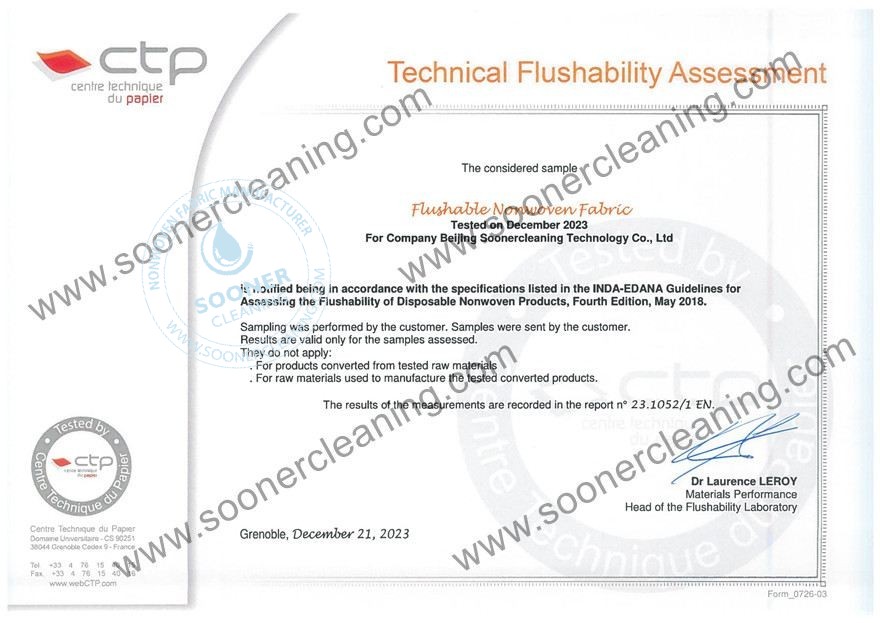
As regulatory pressure intensifies across North America and Europe, the ability to supply verified GD4-compliant flushable nonwoven fabric is no longer a “nice-to-have” capability—it is a market access requirement. Forward-thinking wipes manufacturers are already transitioning their supply chains to certified flushable materials, positioning themselves ahead of the regulatory curve while meeting growing consumer demand for genuinely sustainable products.
1.INDA/EDANA Guidelines for Assessing the Flushability of Disposable Nonwoven Products (GD4), 2022 Edition
2.GB/T 27728.1-2024 – Wet Wipes and Similar Products – Part 1: General Requirements
3.2026 Wiping Materials Conference Proceedings, China Nonwovens & Industrial Textiles Association
4.EU Green Claims Directive (Proposal COM/2023/166)
5.Minnesota HF 3491 – Wastewater Infrastructure and Flushable Wipes Regulation
Disclaimer: This article is for informational purposes only. Manufacturers should consult with qualified regulatory counsel for product-specific compliance guidance.